HeyGen’s Avatar IV is an AI-powered video generation platform that turns a single photo and an audio track into a talking, moving person. The system, which runs on over 18 billion parameters, recently underwent a significant optimization process on Google Cloud’s TPUs (Tensor Processing Units). The result is a pipeline that’s nearly twice as fast as the original version, while maintaining the same video quality.

How Avatar IV works
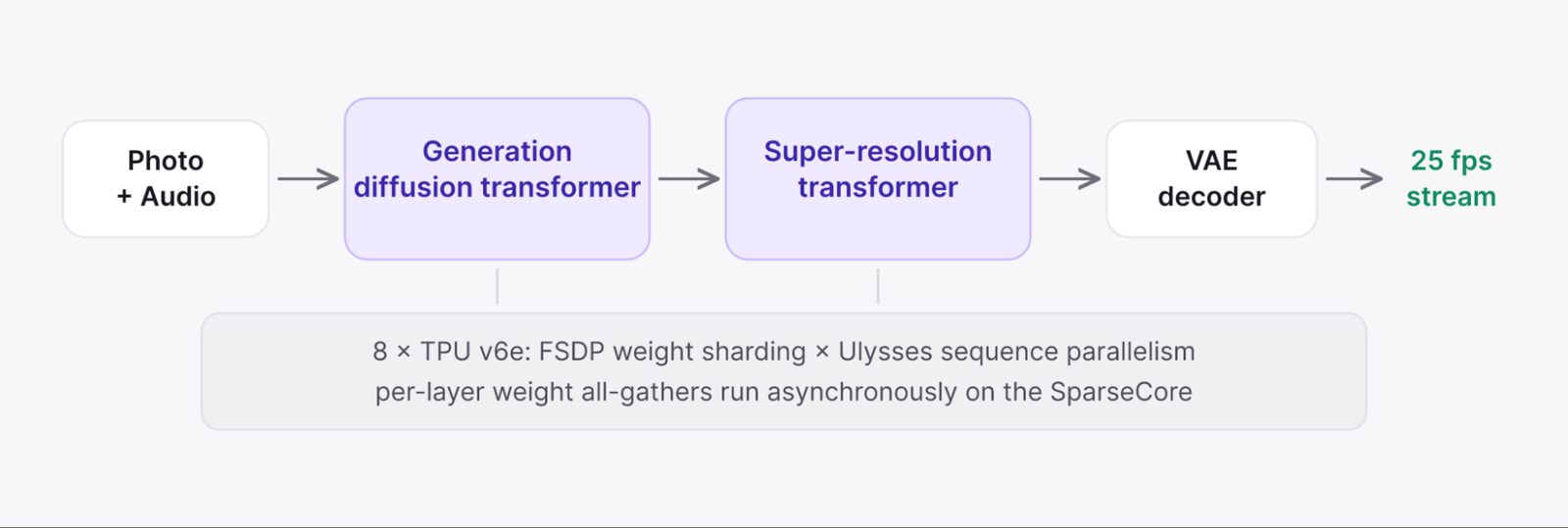
Avatar IV uses a three-stage process to generate video:
- A diffusion transformer renders motion based on the audio input
- A second transformer super-resolves the video
- A VAE (Variational Autoencoder) decoder converts latent representations into pixels
The output is 720p or 1080p video at 25 frames per second, streamed chunk by chunk. This means playback starts while later chunks are still rendering, creating a seamless viewing experience.
The optimization process
The optimization focused on three main areas:
- Parallelism: The pipeline uses FSDP (Fully Sharded Data Parallel) sharding across eight TPU chips, with Ulysses sequence parallelism splitting the video sequence itself.
- Attention mechanisms: Custom attention kernels replaced stock ones, with specific optimizations for sparse attention patterns.
- Compiler contracts: Explicit agreements with the compiler about layout and scheduling led to significant performance gains.
Key improvements
The optimization process achieved a 1.86× speedup, with six major milestones:
| Milestone | Speedup | Description |
|---|---|---|
| 1 | 1.00× | Initial TPU version |
| 2 | 1.30× | Custom attention kernels |
| 3 | 1.45× | Sequence-parallel layout |
| 4 | 1.60× | XLA flag tuning |
| 5 | 1.75× | Kernel tile size matching |
| 6 | 1.86× | Softmax optimization |
Maintaining video quality
Every optimization passed strict quality gates:
- Byte-identical output: Video must hash equal to baseline, frame for frame
- BF16 similarity band: Changes that alter reduction order must stay within narrow numeric bounds
This ensures that speed improvements don’t come at the cost of visual quality.
Cost efficiency
The optimized pipeline is up to 25% more cost-efficient per minute of generated video compared to the original GPU-based setup. This makes it a compelling option for large-scale video generation tasks.
What this means for learners
If you’re learning to build with AI video generation tools, this optimization demonstrates several important principles:
- Hardware matters: Different AI tasks may benefit from different hardware architectures
- Optimization is iterative: Significant improvements often come from many small changes
- Quality is paramount: Speed gains must not compromise output quality
Tip
When working with AI models, always establish clear quality metrics before starting optimization. This ensures improvements don’t degrade your output.
Conclusion
HeyGen’s collaboration with Google Cloud shows how careful optimization can significantly improve AI model performance without sacrificing quality. The 1.86× speedup and 25% cost efficiency improvement make Avatar IV a more accessible tool for video generation tasks.
Want to try all of this hands-on? Start with the free Vibe Coding 101 course.
Source
Based on Google Developers Blog’s announcement, “HeyGen x Google Cloud: Bringing Avatar IV to TPUs”. Written for people learning to build with these tools.